Showing posts with label Family. Show all posts

Monday, 10 June 2013

Spring Cleaning

When I moved to Botswana, I stored most of my personal effects at my father's house -- the house I grew up in. 

Prior to leaving, I spent many weekends at Dad's house sorting through some of my late mother's things.  I didn't get through it all.  Some processes take time, especially when they evoke memories. 

My father lived for all that time, navigating around my things and my mother's things.  A couple of times when we were speaking on Skype, he talked about donating some old clothing and other items to the many charities knocking at his door.  I asked him to please wait until I returned. I wanted to make sure we didn't give away anything of measurable or sentimental value. 

Of course, I am likely the most sentimental one in the family about some things.  I realized that when I looked through the contents of my old childhood bedroom closet.  I kept school books from the first grade onward, newspaper articles, plus some cherished toys.  You see, I was going to become a famous author, and some day, someone was going to need articles from my childhood for the "Stephanie Bishop Museum".  My followers would want to see what influenced and shaped my worldview, right?  What can I say?

When Dad recently expressed an interest in moving to a retirement home in Ontario to be closer to my brother and the grandkids, I knew the time had come to take stock of the household inventory.  I didn't want the daunting task of clearing out and packing up a house to hinder his move, if and when the time comes.

We figured that even if he doesn't move soon, we would still need to clear out the things he no longer needs or uses -- things that are just getting in his way and could better serve their intended purposes with others. 

Afterall, he is now one person, living in house outfitted for a family of four, with odds and ends that had accumulated over close to forty years.  

Knowing it would take too long to tackle this task on our own, we decided to call in the pros.  Yes, we hired a professional organizer to help us make the tough choices about what to keep and what to send away. We hired, Anita, The Clutter Helper, for her experience working with seniors.

We undertook this process over the course of five days, sending heaps of once loved goods for donation and recycling.  We also took advantage of Anita's services to set up a new filing system to help my dad manage the mountains of paper that come to the house.

The task is now done, and I hope the house will now be a little more liveable for my dad.


Anita, The Clutter Helper, taking away a load of donations.

The garage as a staging ground for charitable donations and eco-centre contributions.
Clearing out my childhood bedroom. 


Of course, some things just had to be saved !

Tuesday, 14 May 2013

My hands are small...

My hands are small, I know
But they're not yours, they are my own
And I am never broken
We are never broken
We are God's eyes.  God's mind.  God's Heart. 
We are God's hands.
(Jewel)

My nephew, Henry Robert William Bishop, came into this world Saturday, May 11 at 25 weeks gestation, and weighing 850 grams.  He is in the care of the NICU staff at McMaster University Hospital in Hamilton, Ontario, steps away from his daddy's lab.  Russ and Kari will be frequent visitors at Henry's bedside in the weeks and months ahead.  You are in good hands, Henry.
Love, Aunt Stephanie

Wednesday, 24 April 2013

...And Then Some !

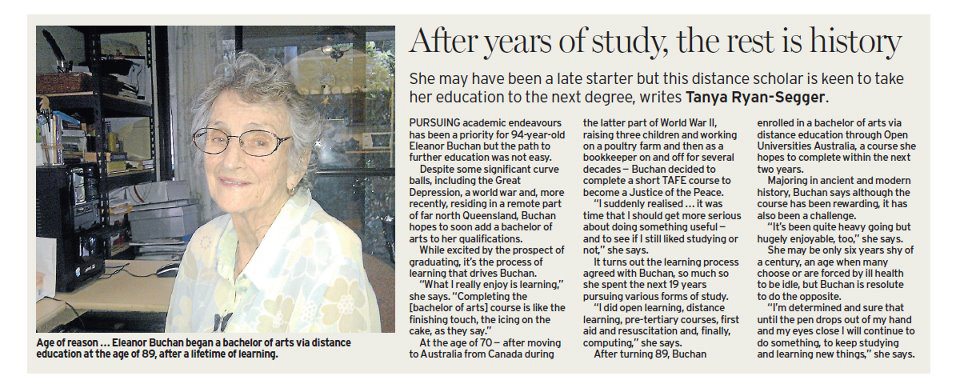
My Aunt Eleanor was a true inspiration to all of us. 

She was the eldest of 5 siblings, raised in Montreal, Quebec.  My father describes her as an "ice-breaker" who cleared the waters for her younger siblings.  She challenged convention and tradition to make life a little easier for those following along behind her. 

Aunt Eleanor had a war-time romance with a young Australian airman.  They married and settled in Australia, where they raised three children and a lot of chickens. 

My father was 13 years old when his eldest sister left Canada.  Aunt Eleanor remembered a gift he sent to her -- a glass perfume atomizer -- with a note proudly stating, "I paid for this with my own money."

Apart from a brief reunion when Aunt Eleanor returned to Canada for a visit in the 1980's, they hadn't spent any time together as adults.

In October of 2011, I took my then 80 year old father to Austrailia to visit his sister.  It had been his dream to visit her for many years, but the timing was never quite right. 

We crossed the ocean and made the trek to Far North Queensland, driving up the winding ocean road from Cairns, past sugar cane plantations, to the peaceful village of Wonga Beach. 

It was a touching reunion, with short daily visits, a trip to a nearby animal sanctuary, and the reliving of fond memories over copious cups of tea.  Aunt Eleanor said she had always wondered what kind of man the sweet little boy she once knew had become.  I think she was pleased with the outcome.

On our first visit, we found Aunt Eleanor working on a university paper at her desk.  The paper she was preparing was for a creative and professional writing unit.  Her eyes sparkled as she described the character development and plot turns of her story, a tale about a young university student. 

Aunt Eleanor was at the top of her class as a student in Montreal.  She had been offered a university scholarship, but was a little ahead of her time.  In the late 1930's Montreal, a young woman was expected to work or raise a family. 

At the age of 89, she started working towards a bachelor of arts degree in ancient and modern history -- proving it is never too late to pursue your dreams.  She did this through distance education courses, and had to first become proficient in computers and online research methods.  Aunt Eleanor soon gained recognition as the eldest university student in Australia.

Along with her research skills, her writing skills blossomed.  She won several awards for her poetry.

Aunt Eleanor shared a copy of her memoirs, called, "My Twentieth Century".  At the time of our visit, she was working on editing the sequel, called, "...And Then Some".

On our last day visiting with Aunt Eleanor, my dad gave her a pretty little glass perfume bottle we picked up in Port Douglas, along with a card saying, "I paid for this with my own money."  She was delighted.

My Aunt Eleanor passed away on Monday, April 22, at the age of 95. 

She will be fondly remembered and dearly missed by us all....And Then Some !

Brother and Sister Reunion, October, 2011.

My famous Aunt, 2012.

Saturday, 8 December 2012

A letter to my niece

My 10 year-old niece, Isobel, sent me a letter with some questions about how and what I am doing in Africa.  My whole family sent letters to me, in response to a request from the organizers of a recent staff retreat.  Isobel, in particular, asked some very good questions -- some that others have asked me before, and a couple that no one has ever asked me before.  I thought I would share my answers:


Dear Isobel,
Thank you for your letter.  It was a nice surprise to get letters from all of you – you, your sister, your Dad, Kari, and your Grandpa Bill.  My colleagues who organized our staff retreat planned that surprise for us.  When you are living far from family, it is so nice to get letters from home.

Thank you for telling me a bit about your life.  It is good to know that you have so many favorite colours.  That will make it easy to shop for you!  Orange and brown are very popular colours here now. 
I am looking forward to hearing you play the guitar when I see you again.  By then, I am sure you will know more than 4 songs.  I would also like to hear your sister play the Charlie Brown Christmas song on the piano.  Please let her know I am happy to hear that she is still involved with music.

I would like to see you riding horses again.  You wrote that you are “starting to jump horses a couple of feet high”.  Although I knew what you meant, I had to laugh, because I had a picture in my mind of you leaping over miniature horses.  I watched you at riding lessons when you were just 5, and even then, I was impressed with your skills.  You were doing acrobatics, flipping from one side of the horse to another.  I thought you were very brave!
Isobel, you asked some very good questions about what and how I am doing here in Africa, and I will answer them.

Is it everything you expected?
Although I had been to other countries in Africa before (Rwanda, Kenya, Tanzania, and Morocco), I had never been to southern Africa.  I wasn’t sure exactly what to expect to find in Botswana, so I did some research before I came. 

I learned that Botswana is a peaceful, stable country. Botswana had been spared the wounds of deep seated colonialism and Apartheid that were experienced by its neighbours. 

I have found that the people I meet here are very kind, gentle, and tolerant.  Maybe this is a reflection of their history as a nation -- or, maybe their history as a nation is a result of who they are, as people.

I also learned that Botswana is the number one diamond producer in the world, and because of this, it has been granted middle income status. The government has wisely invested its revenues in infrastructure and services, so it has good roads and schools.  However, once I came here, I learned that the wealth is concentrated in the city, and there are still many people living in poverty.  

I am working with a national organization that provides support and services to people living with an illness called HIV that can progress to AIDS. Although HIV and AIDS impact people from all segments of society, those most vulnerable are those who live in poverty.  Before I came here, I expected to see more people who look sick, but there are medications now that allow people with HIV to live relatively normal lives. The reality is that 1 in 5 people live with HIV, but you wouldn’t be able to pick them out in a crowd. 

If you want to learn more about things like colonialism, Apartheid, and HIV and AIDS, I can tell you more in another letter or when we see each other again. 

Is it too hot in Africa?

Right now, it is very hot here in Botswana.  While it is winter in the northern hemisphere, it is summer here in the southern hemisphere.  The sun is at its most intense right now at the Tropic of Capricorn, which happens to pass through Botswana.  Days here usually reach above 30 degrees Celsius, and sometimes temperatures get close to 40 degrees.  I am fortunate to have a pool to cool off in and air conditioning at home.  However, I don’t have air conditioning at my place of work, so it can be a little hard to handle.

Our winter (your summer) was quite cool.  It got to close to freezing at times.  Most homes and buildings are not heated, so people have to bundle up. 
Will it change the way you think?

This is a very good question, Isobel. 
One of the reasons I enjoy living in and traveling to different countries is that it does challenge the way you think about the world, and about yourself. 
When you go to a new county, it’s a bit like being a small child again.  You have to relearn how to do many things: how to count change; how to get places; how to cross the street safely; how to greet people; and how to eat new foods.  Sometimes, you have to learn a new language.  You have to think again about how to do very basic things.
You may come with a set of expectations about how people should act, and then learn that they have a whole different way of doing things.  Sometimes we need to remind ourselves that there is not only one right way to do things.  There are always reasons for the way we and others do things, and it's good to think about what those reasons are.
Sometimes, people may react to you based on how you look, where you are from, and what you may represent to them.  That gives you an opportunity to learn about how their history and experiences have shaped the way they think -- and also to think about what has shaped the way you think about the world.  
I wish many things for you and your sister, and one of them is that you, too, will have the opportunity to experience life in other countries.  Living in other places not only changes the way you think -- it also broadens and expands the way you think.
Do you even like it there?

I am enjoying it here, very much, Isobel.  
My favorite part of the day is my morning walk to work.  I pass many friendly people, who always say “Dumela” or hello with a warm smile.  I also see beautiful trees and blossoms.  I especially like the purple jacaranda blossoms and the red flame tree blossoms, both of which are blooming right now. 
I like the people I work with.  They are very passionate about what they do, and they know they are making a difference in peoples’ lives.  It is a pleasure to work with them.   My other wish for you and your sister is that you will find something to do in life that you are passionate about and is meaningful to you and those you touch.
When I come home in the evening, I take a few moments to watch the weaver birds building their nests in the tree in the courtyard.  I tried to count them, and there are more than 100 nests in one tree.  Then, if it is still hot, I take a dip in the pool and make myself dinner. 
Sometimes on weekends, I will go to a concert or out for dinner with friends.  I see different parts of the city when I go on weekly walks with a hiking / running club. 
My all time favorite thing to do when I have is enough time is to go on safari.  I never get tired of looking at animals.  They are always doing something different.
Is it safe?

Botswana is a relatively safe country, and has been fortunate to avoid the political and social turmoil that has touched many of its neighbouring countries.  I am not worried about things like political coups or wars breaking out.
I walk a lot in Gaborone, and I feel safe when I pass by friendly faces on the streets. I am careful to take taxis when I go out at night, though.

Like most places in the world, crime is a problem here, and people take precautions.  Many people live in gated houses with guard dogs.  I have six keys I need to use to get into my house: a remote control for the front gate; one key for the main house; another for the entry into my unit; another for my bedroom; one for the door to the courtyard patio; and one for the side gate.  So, I feel safe at home when all the doors and gates are locked.  We don’t have any guard dogs, but our neighbours’ dogs would kick up a fuss if anything strange were to happen. 
Although -- I do confess that I am not convinced that walled and gated houses are really the safest places to live.  It is very easy to come and go without seeing your neighbours, which is not good if you do not know if this or that person going into a house is the person who lives there.  I have a friend who lives in a neighbourhood without the big walls.  She knows all her neighbours, and they look out for one another.
You may also be wondering if I have encountered any safety issues with wildlife.  So far, I have managed to avoid dangerous encounters with poisonous insects and snakes.  I have been on several safaris, and although I have never felt threatened by the wildlife, I woke up to the sound of a lion growling next to my tent one night when I was camping!  Needless to say, I didn’t get back to sleep that night.


Isobel, I will be thinking about you and everyone at Christmas, and I am looking forward to seeing you in the New Year!  Please write again to tell me more about how you are doing and to ask more questions.

Much Love,

Aunt Stephanie

Sunday, 11 November 2012

Remembrance Day

Today is Remembrance Day. It is a significant day for my family, as my maternal grandfather, Lt-Colonel J.N. Edgar, was a veteran of World War I and World War II, where he served with Princess Patricia's Canadian Light Infantry. 

My most treasured family photo is of my mother as a young girl, standing beside her father and mother, her little brother in his daddy's arms, in front of the Empress Hotel in Victoria, British Columbia. Granddad was wearing a pith helmet and holding the telegram with his World War II departure orders in one hand.  They were bidding him farewell, not knowing if they would ever see him again.  My mother, grandmother, and grandfather were bravely smiling for the camera. If you cover their smiles, their eyes reveal their true feelings. Four year-old Uncle David was unable to muster a smile.


I was 3 years-old when my grandfather passed away, and my vague memories of him are triggered by family movies and the pride in my mother's face and voice whenever she spoke of him.  My brother recently shared this memory of a conversation with him:
"He died when I was 5, but not before I asked him if he would be fighting in the 3rd world war. He laughed, and then told me that if there is ever a 3rd world war we wouldn't be needing soldiers. It took me a while to figure out what he meant. I guess that is why we have Remembrance Day."
My brother has been researching our family's history, and came across this record of his receipt of the Military Cross for his deeds at the battle of Cambrai in 1918.  A young captain at the time, he was recognized for his courage and leadership when he stepped up to lead his troop to safety after the commanding officer had fallen.


Granddad's medals are housed at the Museum of the Regiments, in Calgary, Alberta.  I stop by to see them whenever I am in Calgary.  If you happen to be in the area, pay a visit to honour our veterans and learn a bit about how our history has shaped our present.


Saturday, 20 October 2012

Namibia: Desert Life

Deserts amaze me.  They always have.  I am always astounded by how much life they sustain.  It's all around you -- if you take the time to look and listen.


On my trip through the Namib desert with Max and Judy, we saw baboons, ostriches, oryx, springbok, mountain zebras, jackals, and guinea fowl. 

At the sand dunes, we saw Tok Tokkie beetles, named for the sound they make.  They have extra long legs that keep their bellies from the hot sand, and allow them to do a headstand to catch and channel morning dew, that then trickles down their bodies into their mouths.

We also saw signs of human life, past and present.

We saw 2,000-4,000 year old San cave paintings at Bushman's Paradise, Spitzkopp Mountains, and we visited the small settlement of Solitaire, where they serve the best apple strudel, this side of Germany.

Our Namibia tour guide, Ronny, and our guide at the Bushman's Paradise were both from the Damara tribe in the area, and spoke a wonderful language of clicks.


Tok Tokkie beetle.
Graceful oryx.


Cactus flower.
 
This is a poisonous cactus !

Quiver Tree (Aloe Dichotoma)


Our guide explains the significance of this rhino painting.  The horn is pointing to a water source.

Can you see the stripes of the zebra ?

There are people in this one, moving west.
Driving through the Spitkzkopp Mountains.

We have time for a little hike.


Welcome to Solitaire, home to a service station, lodge, and yummy baking !


Solitaire is named after this lone tree.

Annual and monthly rainfall, Solitaire, Namibia.  It looks like 2011 was a good year (relatively speaking) !

Namibia: Sand and More Sand

Max, Judy and I had a couple of days to take in the vast expanse of the Namib Desert.  Did you know the Namib Desert is the oldest desert in the world ?

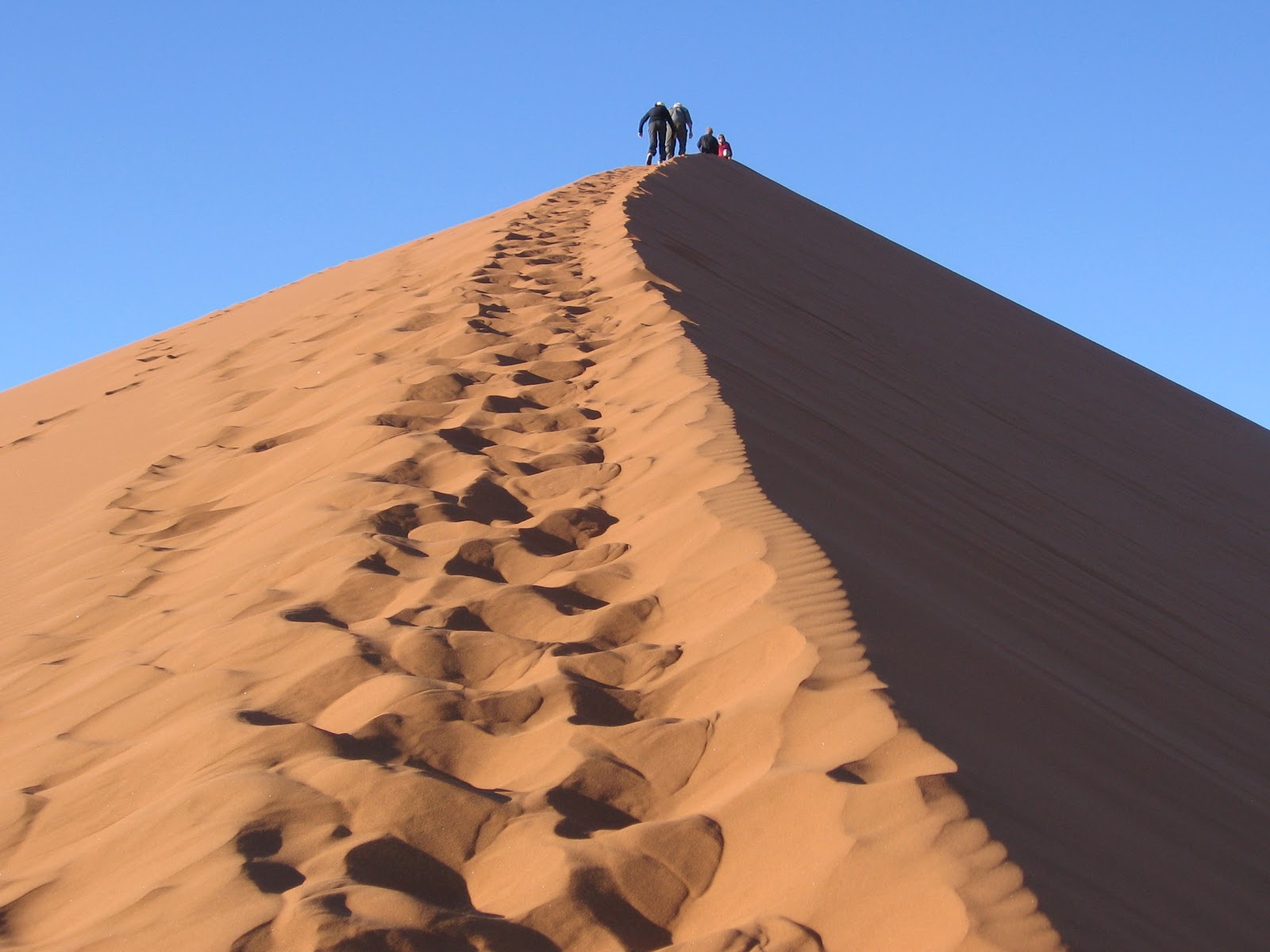
While there, we visited Sossusvlei, a salt and clay pan surrounded by the highest sand dunes in the world, in the Namib-Naukluft National Park.  We climbed Dune 45, the highest dune at 250 metres.  We also visited Deadvlei, the sight of a flood 300 years ago that suffocated a forest of trees.


Ghostly trees of Deadvlei.


We hiked the 5km from Dune 45 to Deadvlei.
We took an other worldly flight-seeing tour over the desert.
Judy, on top of Dune 45.

The trucks on the lower right corner give some perspective to the height of this dune.


My foot, descending the giant dune.  It took days to get the last grains of sand out of my shoes.


Thursday, 11 October 2012

Flowers

In tribute to my late mother, whose birthday was October 11, and who loved flowers.  These flowers are from Kirstenbaush Botanican Garden, in Cape Town, South Africa.