Showing posts with label HIV and AIDS. Show all posts

Friday, 4 January 2013

Christmas Road Trip - Swazi Village

On Christmas morning, we wrapped sarapes emblazoned with the King's face around our hips and made a short trek to a local village.  In the village, we were greeted by the Chief, a grandmotherly woman who inherited the title from her late husband.  Female Chiefs are not too common in patriarchal Swaziland.  The Chief happens to be a member of the Swazi Royal Family, and is King Mswati III's aunt. 

Swaziland is the last absolute monarchy in Africa.  The Swazi King prides himself on upholding local traditions, including the practice of polygamy.  He currently has 14 wives.  He is also known for his lavish and opulant lifestyle, which is criticized by some as being maintained at the expense of addressing the many challenges that plague the citizens of Swaziland, who have the dubious distinction of living with the highest HIV prevalence rate -- and the lowest life expectancy -- in the world.

The Chief doesn't seem to benefit from the Royal Family's wealth, and instead, invites tourists to her homestead as a means of raising funds to provide for the 327 AIDS orphans under her charge.  It was a pleasure to spend Christmas morning with her and the kids, as they took us through their daily routines and patiently taught us songs and dances.


As you can see, I couldn't get enough of this little warrior.


I am grinding cornmeal for the children's Christmas lunch.
The Chief.
Our guide, demonstrating Swazi attire.

Sunday, 2 December 2012

International AIDS Day, December 1, 2012

I attended the International AIDS Day event in Mogiditshane, outside Gaborone, yesterday. It was a rainy, blustery day, but the crowds, exhibitors, and entertainers showed up in full force.  With a national prevalence rate of 17.6%, it is estimated that 301,807 people are currently living with HIV in Botswana.  Events like this to share information and resources are part of a national awareness and prevention campaign.


Building an HIV Free Generation

Young girl, showing her support
Display at the WUSC booth


Even "Ex Toughmen" want to learn about the benefits of safe male circumcision

The HIV testing caravan behind the BOCAIP tent had a steady line of people wanting to know their status

BOCAIP banner
Pearl, the face of BOCAIP

The links between gender based violence and the spread of HIV are undeniable
Traditional dancers entertain the crowd


The President and other dignitaries show their support


Tuesday, 27 November 2012

"It's a hard life"

Those were the last words I heard from Violet her last day working at our house.  She had been having some issues with her boss, our landlord, and it was time for her to move on.  When she said it, she had tears in her eyes.

Violet had become a dear friend to me.  She had a soft spot for Canadians, having worked for one before.  She was the last person I saw each morning when I left the house for work, and the first to greet me when I came home in the evening with a “Hello Sweetheart” and a warm smile.  
Although my housemate and I miss her, we are relieved that she is now in a better, less stressful environment.  She had been having issues with her boss for some time, and we tried to walk the fine line between being supportive and interfering. 

Domestic workers have little recourse when they experience conflicts with their bosses.  For those who are working legally, Botswana has labour laws that are intended to govern their working relationships.  Unfortunately, these laws offer less protection than for other working populations. Domestic workers have little clout in negotiating wages and working hours, and are not even entitled to the full suite of public holidays. As of yet, there is no union to hear or mediate their grievances, and legal aid is still a relatively new concept here. Those working illegally (there is an underground economy of workers from neighbouring countries) are even more vulnerable.
A Botswana based human rights organization, Ditshwanelo, has done some work in the past to articulate the issues impacting domestic workers and to encourage the development of a union.  They acknowledge that both domestic workers and their employers are poorly informed about their respective rights and responsibilities.

The issue of disclosure about HIV status is one that comes up again and again.  Some employers believe it is their legal right to know the HIV status of their employees, particularly those working in their homes.  It isn’t.  However, there is still a lot of stigma attached to HIV.  Workers who are afraid to disclose their positive status have to find creative ways to keep their medical appointments, take their medication, and tend to their health care needs. 
I think if I had more time and authority in this country, I would work on supporting Ditshwanelo to strengthen and advocate for the rights of domestic workers, particularly those whose health is compromised. 

While I can’t single-handedly make systemic changes, the very least I  can do is try to make at least one domestic worker’s life a little less hard.
I managed to find Violet and travelled to her village to visit her.  She greeted me at the road side with her warm smile, wearing her Sunday best.  She took me by the hand and walked me to her church, which was in mid-service.   She sang loudly and proudly to the beat of a cowhide drum as a little boy, cloaked in a red and white robe, led the small congregation in dance.   We then walked a few steps to the house she shares.   I gave her a necklace I brought from Canada.  She put it on and said she will wear it until the day she dies.  I also gave her a bonus I had originally been saving for her for Christmas.  She sighed with relief, and sent the little boy to buy milk and sugar so we could enjoy a cup of tea together. 

Monday, 29 October 2012

This is Why: Part II

There is a young lady who came to our office a few months ago to volunteer as an intern in our Finance Unit.  I will call her Rose. 

Rose is friendly and flirty and loves to sing.  She is also a hard worker, and one of the first to arrive at the office each morning.  

Recently, BOCAIP was able to bring Rose on staff in a casual position as an Accounts Clerk. 
In the morning devotions, Rose eagerly volunteers to read bible passages and lead the discussion sessions.  When we come to the part for prayer and thanksgiving requests, Rose often gives thanks for having BOCAIP in her life.

You see, Rose has grown up with BOCAIP in her life.
She was orphaned as a young girl, and attended BOCAIP’s teen club* in Molepolole.  It was a place she could call home, where she found guidance and a sense of direction.  She remembers performing in a dance troop for Mma Kwape and the BOCAIP board. 

So, when she had to find a placement for her college internship, she naturally thought of BOCAIP.

The other day, Rose shyly announced that she will graduate from her Finance Program this Friday.
Mma Kwape looked at her, and then to the rest of the staff, and said:
“This is why I still do what I do for BOCAIP.  It is young girls like Rose that keep me doing what I am doing.”
When Rose graduates, her BOCAIP family will be there to cheer her on.

*BOCAIP no longer has funding for a teen program in Molepolole, but continues to provide day care services and home visits for families with orphaned and vulnerable children under 6 years of age.

This is Why: Part I -- Update
Last week, Bonolo and I went to Ramotswa to visit the family I wrote about earlier.   

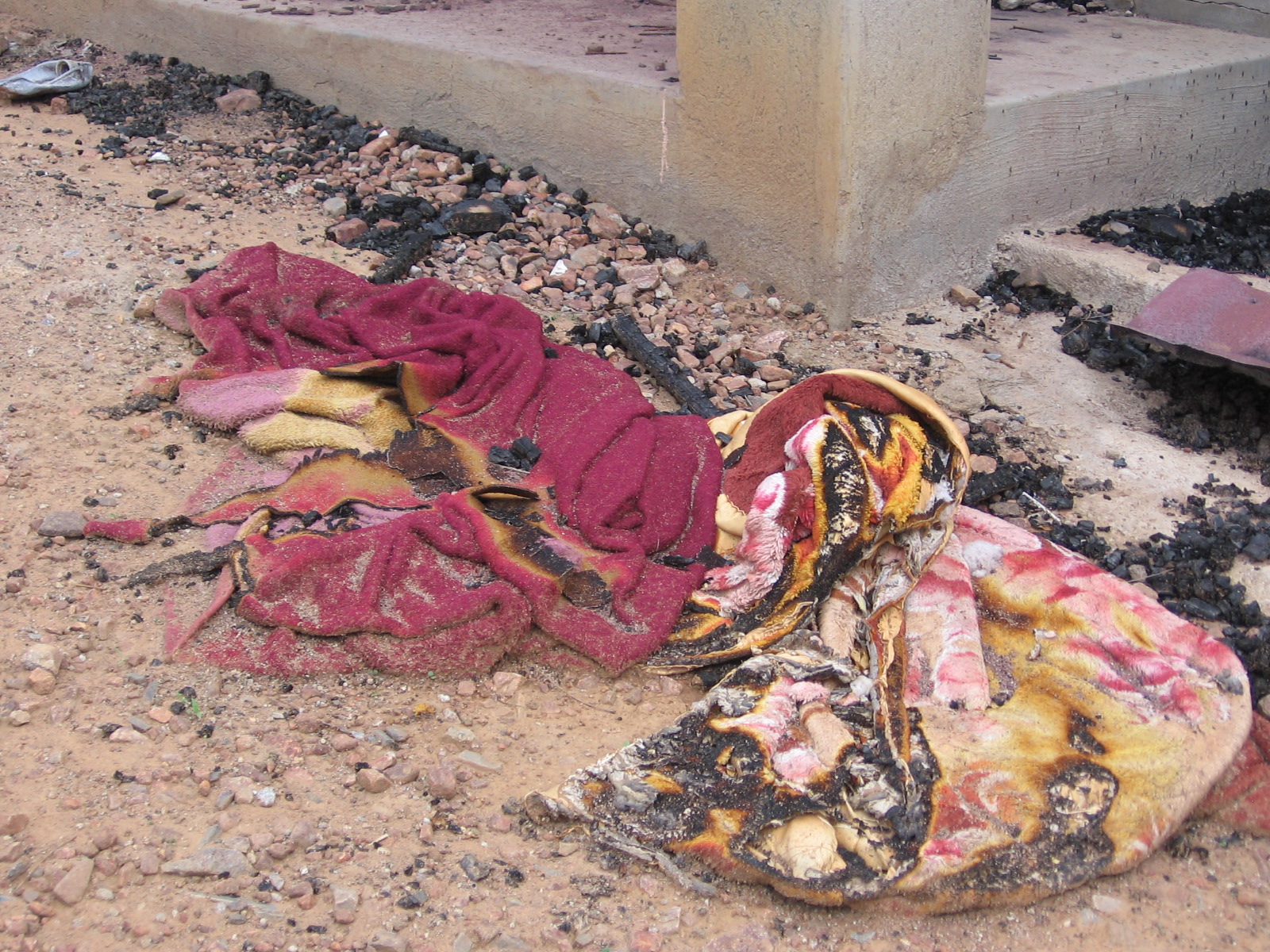
We stopped by the site of the fire to take photos to show potential donors and builders we hope to mobilize to rebuild the house. 

We visited with the two eldest children and their aunt, to give them the donations we had gathered from staff and contacts.   

They were very grateful to the strangers who had reached out to them, but disappointed that neighbours, colleagues, and the local social services had not yet stepped up to help them. 

The girl said something I won't soon forget: “Vision 2016* isn’t working for us.”  

Charred blankets outside the house.

Vision 2016 isn't seen so clearly through a window of debris.

I hope that will soon change.  

When we were exploring the remains of the house, a neighbour passed by to tell us that a village council (khotla) meeting had been called for the coming weekend to determine a community response to this family’s crisis.   

I have come to learn that in Botswana, when a crisis arises, it is normally expected that the extended family will pitch in. That might explain the slow community response. But what do you do when your extended family is no longer there for you? When we were visiting the family in the uncle's house, the children's aunt showed me a wall of photos of family members who had all recently passed on.  It made me wonder how Botswana, as a nation, carries on in the midst of so much grief...but maybe that is a topic for another post.

As for Vision 2016, I can’t say what will come from the national response to crises like this.  

The government provides material support for orphans and vulnerable children, such as help with school fees, food and clothes, but there is still a gap in the kind of psycho-social support that these kids need -- a gap that civil society organizations, like BOCAIP, are trying to fill. 

*Vision 2016 is Botswana's national development strategy, in commemoration of what will be Botswana's 50th anniverary of independence.  Seven key pillars or goals have been developed to achieve the strategy, including striving to become A Compassionate, Just and Caring Nation:

"By 2016, Botswana will have realized a more equitable income distribution that ensures that the majority of its people participate in economic activities. As a compassionate and caring nation, Batswana will have the poor and underprivileged considered in their daily activities. Poverty will be alleviated. Government, in a smart partnership with the private sector and non-governmental organizations, will provide social security to the elderly, the terminally ill, orphans and people with disabilities. By 2016, Batswana will have access to quality health facilities. Health facilities will be within a reasonable distance. Botswana will be prepared to deal with unexpected epidemics and any natural disasters. There will also be adequate nutrition, quality sanitation and adequate supply of clean drinking water. The spread of Human immuno-deficiency virus (HIV) that causes Acquired Immuno-deficiency Syndrome (AIDS), will be stopped. AIDS patients will have access to quality care in health facilities, in their community or workplace. "    


Monday, 15 October 2012

This is Why: Part I

Sometimes, it doesn't hurt to ask

"Donations requested for Ramotswa family"

This was the subject line of an e-mail message I sent to my network of friends and colleagues. (I have been here long enough now to have a network.)

I am not comfortable requesting donations, but I have come to learn that, sometimes, it doesn't hurt to ask.

Mma Kwape had been approached by a woman with family in Ramotswa who had just lost their home and all their household and personal belongings in a fire.

The family is headed by a young woman in her early-20's, herself, the single mother of a 6-year old boy, who has been looking after her younger brother and sister, in college and high school, respectively, since they became orphaned earlier in the year.

Child-headed families like this are an all too common occurance in Botswana today, where 17 out of every 100 children are orphans.

Their mother succumbed to an AIDS related illness.

She had worked hard, despite her advancing illness, to leave her children the security of a 3 bedroom house. 

Unfortunately, they didn't have insurance. They lost everything, except the clothes on their backs. 

The woman who approached Mma Kwape, the children's aunt, is not able to take them in.  They are temporarily staying with an uncle, but it is not a permanent solution.

The BOCAIP staff decided that we would check our cupboards and closets at home to see if there is anything we can donate to this family.

I decided to extend the call to my broader personal and professional network.

The response was swift and generous.

This morning, a donation came in from WUSC of gently used linens and bedding left behind by past volunteers. 

We also decided to call and write to the managers of the local grocery stores, to see if they have any left-over or near the end of shelf-life stock they can donate.  We have had positive and sympathetic responses, so far.  Mma Kwape has even been in touch with a local bank.

Our next step will be to approach businesses and embassies for support with rebuilding the house.

Sometimes, it doesn't hurt to ask.

This is Why

Upon further discussion with the children's aunt, Mma Kwape realized that they are in need of more than pots and pans, pasta and toothpaste.  They are also in dire need of psycho-social support.

They are dealing with issues of trauma, grief, and guilt (someone left a candle burning).  We also learned that the young girl in high school is HIV positive.  The prevention of mother-to-child transmission programs that are so successful today did not exist when she was born 18 years ago. 

BOCAIP is well positioned to connect this family with counsellors and social workers to help them work through these issues.  Our staff will visit them soon.  They will also make sure the young girl has the medical support she needs, and that the family gets the government services for which they may be eligible. 

Some folks way wonder why I decided to come here.  This is why -- to support civil society organizations like BOCAIP become sustainable, so they can continue to respond to situations like this, impacting families affected by HIV and AIDS.

This is why.


Monday, 11 June 2012

What's new at BOCAIP ?

...So glad you asked !

BOCAIP is moving full steam ahead with implementing the Maatla Project.  I went with Mma Kwape and a team of advisors from FHI360, the American NGO coordinating the Maatla Project, on a site visit to the village of Molepolole.  We visited the Orphans and Vulnerable Children (OVC) day care centre and the HIV counselling and testing centre to see some of BOCAIP's projects in action.


FHI360 Advisors visit the OVC centre in Molepolole
Taking children home after a day of fun at the day care centre.
 I love this little guy's smile !
Health promotion posters on display at the counselling / testing centre.

Mma Kwape being interviewed at the May 10 launch
BOCAIP also launched a project funded by the South African Development Community (SADC),  through which support is provided via umbrella organization in Botswana, Zambia, and Zimbabwe to develop the organizational capacity of 10 civil society organizations in each country working to address HIV and AIDS.  BOCAIP was selected as the organization to lead this project in Botswana.  I will be working with BOCAIP to ensure links are made, and lessons shared, with partners working on the Maatla Project. The umbrella organizations from Zambia and Zimbabwe, along with BOCAIP, are participating in Train the Trainer sessions this week in Gaborone.

Monday, 14 May 2012

Mother's Day Flowers: One Rose and A Violet

Yesterday was Mother's Day.  I spent the afternoon at a lovely outdoor cafe that is part of a greenhouse/nursery.  I went with two newly arrived volunteers, looking for something to do on a Sunday afternoon.  It seemed a fitting tribute to my late mother to be surrounded by roses on Mother's Day.  I made it a point to smell and appreciate a budding peace rose, Mom's favourite.  My Mother's Day rose to Mom.  Those who remember my mother will recall her fondness for roses. 

We parted ways after lunch so I could prepare for my move (yes, I have moved!).  One of my (now former) housemates, Melissa, kindly offered to take me and my belongings to the new place. 

The housekeeper, Violet, was there to let us in.  As I was transferring my bags to my new room, Melissa chatted with Violet. From the snippets of the conversation I heard, I could tell they were making small talk about Mother's Day.

Violet: "I have one daughter."
Melissa:  "She must be a very special daughter."
Violet:  "Too special !"  (meaning what, that she is spoiled?)

Violet:  "But she is not my only child.  I also look after the children of my late brothers and sisters.  So, I really have 10 children."

At an appropriate time, I will ask Violet more about her life and how she looks after these 10 children.

I don't need to ask what happened to shorten the lives of her brothers and sisters.  Some things just don't need to be asked here.

Violet lives on the property with us, so I am curious to know where the children live, who looks after them while she is here with us, how often she gets to go see them (given she is here 6 days a week), what kind of support and help she gets, if any, etc.  If I find out, I will let you know. 

I am sure there are many more Violets here and elsewhere who deserve a Mother's Day rose.


Sunday, 1 April 2012

The Faces of BOCAIP


I've mentioned BOCAIP a few times, and even shown you the outside of the office building. I thought it was finally time to introduce you to some of my co-workers and explain a bit more about what they do. BOCAIP is the Botswana Christian AIDS Intervention Program, a faith-based organization, established in 1997, that operates programs in 11 centres throughout the country. One of its main programs is HIV counseling and testing. (*see comments for more info about HIV testing.)


On March 24, I sat in on an orientation session for staff from three of BOCAIP's centres who will be providing Provider Initiated Counseling and Testing (PICT). The two lovely ladies on the right work at the national office. Mme Kwepe is the National Coordinator -- a very experienced, dedicated, and inspiring woman. Bonolo, next to her, in the green top, is a Project Officer. The others are supervisors and counselors from some of the centres in outlying communities.


Here is Bonolo, explaining BOCAIP's counseling and testing model.

Bonolo's advice for working through challenges: "Some people are always grumbling because roses have thorns. I am thankful that thorns have roses."


Click on the picture to enlarge it. Let me know if you have any questions about the model.


National guidelines for counseling and testing children and adolescents, and encouraging couples to test together.

Saturday, 24 March 2012

TB or not TB

Today is World TB Day. This morning, I attended an orientation session organized by BOCAIP for front line HIV testers and counselors. Like HIV, TB is a major health issue in Botswana. Since 1989, Botswana has experienced a 3-fold increase in TB incidence and now has one of the highest rates of TB in the world. The increase has largely been attributed to the country`s HIV epidemic. It is estimated that 60-84% of TB patients in Botswana are currently HIV infected. Part of the role of the HIV testers and counselors is to screen for TB, help clients understand the relationship between TB and HIV, and recommend appropriate follow-up treatment and support.

Tuesday, 13 March 2012

Everyday Setswana

I picked up a Setswana phrase book yesterday to help boost my vocabulary.  While glancing through it, I came across some useful - and not so useful - phrases.

Let's start with the not so useful ones:
  • Go semanthane.  There is snow.  I doubt I will use this phrase during my time here.
  • Saka.  Shark.  I won't likely need to shout this out as a warning, on the fringes of the Kalahari desert.
Some phrases that may come in handy, but I hope I will never have to use:
  • PhephengScorpion.  We saw a cousin to the phepheng poking around our gear as we were packing up camp.  Next time, I think I will wear closed-toe shoes when I go camping.
  • NogaSnake.
  • Mokwepa.   Mamba.  I hope I don't have any close encounters with a noga, and especially not a mokwepa.
  • Seteisene sa mapodisa.  Police station.
  • Motseneledi.  Intruder.  Let's hope I never have to go to the seteisene sa mapodisa to report a motseneledi.  
  • The dithibelbogodu (burglar bars) on my windows should deter a potential motseneledi.  I have to admit, it has taken some adjusting to get used to living behind walls, wires, and bars.  I haven't felt threatened in any way, but I guess these precautions are here for a reason.
  • I also hope I will never have to go to the seteisene sa mapodisa to report a kotsi ya tsela  (road accident).  Although many expats buy used cars for the excellent resale value, I am not yet ready to venture out on city streets, especially during pharakano e e pitaganeng  (rush hour).  I think I would get frustrated with the kgotlhagano ya pharakano (traffic jams). 
  • So far, I have been pretty healthy.  If that changes, then I may need to consult a ngaka (doctor) or, perhaps, even a ngaka ya Setswana (traditional healer).  Fortunately, I was introduced to a very nice ngaka as part of my orientation.
 Some phrases I hope to use very soon:
  • Ke rata mninoI like music.  I am planning to go to a pontsho e e tselang  (live show) this weekend.
  • I would also like to try go thala metsing  (sailing).  Believe it or not, there is a yacht club at the Gaborone Dam. 
Some phrases you may not need to learn in other places:
  • KhutsanaAn orphan.
  • DikhutsanengOrphanage.   An 'orphan' is defined by the United Nations as a child who has lost one or both parents. Worldwide, it is estimated that more than 16 million children under 18 have been orphaned by AIDS. Around 14.8 million of these children live in sub-Saharan Africa. In some countries, which are badly affected by the epidemic, a large percentage of all children (for example 16% of children in Zimbabwe and 12% in Botswana and Swaziland), are orphaned due to AIDS.  --  You didn't think I would post another item without including something about my work or Etsi (AIDS), did you ?  BOCAIP offers programs to provide care and support for Orphans and Vulnerable Children, and I will post more about what they do through these programs at another time.
Go sieme ! (Good-bye !)

Thursday, 8 March 2012

Snip ! Snip !


Do you know the public health benefits of male circumcision ? Circumcision can reduce the risk of female to male transmission of HIV by up to 60%. About 11% of males between 10-64 have been circumcised in Botswana. A national public health campaign, supported by BOCAIP and other organizations, is geared to encouraging HIV testing and circumcision amongst the adult male population. BOCAIP is setting up clinics at some of its testing and counseling sites so this can be done in a safe, medical environment, and with appropriate counseling to encourage safe sex and relationship behaviors.

I am young enough to be your daughter...


Youth in the village of Thamaga.

What does the girl's t-shirt say ?


"I am young enough to be your daughter; stay away from me !"

This t-shirt was developed by the Botswana Christian AIDS Intervention Programme (BOCAIP), the organization at which I am placed.
BOCAIP saw a need to address the issue of HIV transmission through inter-generational sex, in recognition that the highest rates of new infection occur in young women, between the ages of 25-30, at 8.73%, and men, between the ages of 45-49, at 8.13%.

*  See "comments" for an explanation.

Why I am here -- The Maatla Project

I thought I should start writing a little bit about why I am actually here, and what I am doing for work -- lest you all start thinking I am only here for the safaris - ha!

Through my placement with WUSC/Uniterra, I am contributing to a Botswana/Canada/USA umbrella initiative called the Maatla Project. Maatla is the Setswana word for strength, and the goal of the project is to support civil society's response to the HIV and AIDS epidemic in Botswana through strengthening the organizational development capacity of 4 core national HIV and AIDS networks to provide prevention, care, and support services at the grassroots level through their member organizations and/or sites. I have been placed, or embedded, in one of the 4 partner networks as an organizational development capacity advisor.

I am so excited about the many layers and textures to this assignment, and hope to describe them all in due time (once I find a succinct way to do so) ! In the meantime, I will prepare a couple of short posts to give you an idea of the scope of the HIV and AIDS epidemic in Botswana, and what is being done to address it, particularly by the network with which I will be working for the next year.

Stay tuned !