"The place we do not want to live"
Katutura, Otjiherero for
"The place where we do not want to live", is a township outside Windoek, Namibia. Katutura was created in the late 1950's following the forced removal of Windhoek's black population under the South African colonial administration.
For many reasons, the residents did not want to move. They owned their own plots in the old location and had buried their loved ones there. In the new location, they had to pay rent to the municipality, their small plots didn't allow space for gardens, and they needed to pay for public transit to reach their places of work in town.
Following protests and a boycott of municipal services, the police opened fire on the protesters on 10 December 1959, killing 11 and wounding 44 others. This event is known as the
Old Location uprising, and it is the reason for the declaration of December 10, Human Rights Day, as a Namibian national holiday.
I took a tour of Katutura while in Windhoek, waiting to meet up with my Australian cousins. My guide, Patrick, was from the Herero tribe and lived in Katutura. We stopped by his house to pick up his lunch. His mother came out of the yard to meet him in her traditional Herero Victorian style dress with a long pointy hat, designed to resemble the horns of a cow.
 |
| Herero women. (Not Patrick's mom. This is from the internet.) |
Patrick explained how class structures had been enforced in townships. The coloured township was closer to Windhoek and had small houses with indoor plumbing. In the black township of Katutura, families were further segregated into tribal areas, and lived in even smaller houses, marked by plot numbers and letters indicating which tribe they belong to: O for Ovambo; H for Herero; D for Damara; and N for Nama. There was no indoor plumbing in the black township, and people could not leave their houses after 9:30 pm, even to go to their outhouse. The ruling regime was afraid that they might gather and revolt. The remains of a police post, from which the police made their nightly patrols of the townships, can be seen just outside Windhoek proper.
 |
| Katutura |
In Katutura, Patrick dropped me off at a community TB and HIV centre.
Given the work I do in Botswana, it was a treat to see how another civil
society organization provides treatment and support for TB and HIV
clients. Like BOCAIP, they have community TB workers who provide
Directly Observed Therapy (DOT) to help ensure the clients take their
medication regularly and on time. The community workers bring fresh
produce, grown from a garden run by the TB clients, themselves, to
ensure everyone has the proper nutrients required to absorb the
medication. The centre also provides training and income generation
projects for the patients. They have two classrooms, where volunteers
from a local college provide classes in finance, computing, and
business. They also have workshops, where the TB and HIV clients produce
beaded jewelery, batik table linens, and olive oil soap. The soaps and
batik linens are sold to safari lodges, and the other goods are sold in
a shop on site. The centre keeps 25% of the sales for purchase of materials, and gives the remaining 75% to the clients who made the
goods, upon completion of their cycle of treatment. I thought this was
an innovative model.
 |
| TB Centre |
 |
| Making soap |
Funky Town
Gotta make a move to a town
That's right for me
Town to keep me movin'
Keep me groovin' with some energy
Well, I talk about it, talk about it
Talk about it, talk about it
Talk about, talk about
Talk about movin'
Gotta move on
Gotta move on
Gotta move on
Won't you take me to
Funkytown
Won't you take me to
Funkytown....
Yes, there really is a place called Funky Town ! After Independence (1990), Windhoek tried to erase the divide between Windhoek proper and the townships with new housing developments. Funky Town is in the area that used to separate the coloured township from Katutura. The houses and stores are painted in bright colours. I didn't get any pictures of Funky Town (this photo of the sign is from the internet), as I kept asking Patrick to repeat the name of the town.
"Did you say, Funky Town ?"
"Yes, Funky Town."
"Funky Town, like the song?"
"Yes, Funky Town."
By the time we established that it really was called Funky Town, we had already passed through.
Don't you think it would be cool to say you live in Funky Town ?
Downtown Swapokmund
We had some time to kill before our afternoon sight-seeing flight over the sand dunes, so our guide Ronny, said,
"Let me show you downtown Swapokmund."
"Aren't we already in downtown Swapokmund ?"
"No, I am going to show you the real downtown Swapokmund."
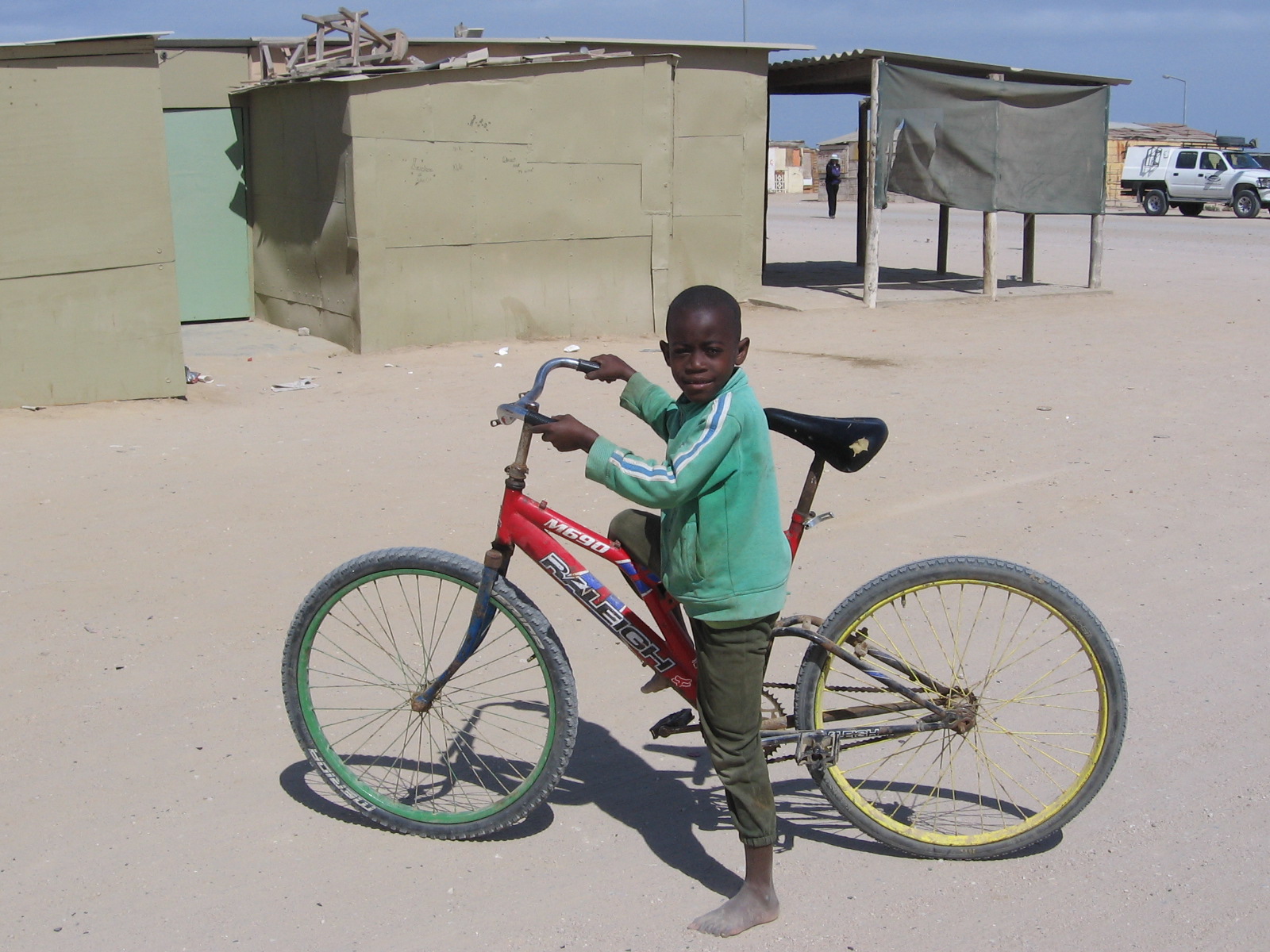
Ronny took us to Mondesa, a sandy township outside Swapokmund. We went for a Sunday morning walk, to the beat of drumming and singing from a tin shack church service. We chatted with the residents, who were going about their Sunday morning activities: gathering water from the communal pump; salvaging nails from discarded building materials; a kid taking a spin on a much too big bike.

My cousin Judy made a friend in a fellow kindergarten teacher, and promised to send some much needed supplies via Ronny.
A boy wearing one sock and no shoes drew a map in the sand to the home of an artist who paints whimisical pictures on t-shirts, and everything else. Judy promised to send some white t-shirts for him in her parcel to Ronny.
Everywhere we turned, we were struck by the resourcefulness and ingenuity of the residents in building their homes and businesses, and the pride they took in the upkeep.